Transcript: Israeli Ambassador Michael Leiter on “Face the Nation with Margaret Brennan,” April 12, 2026

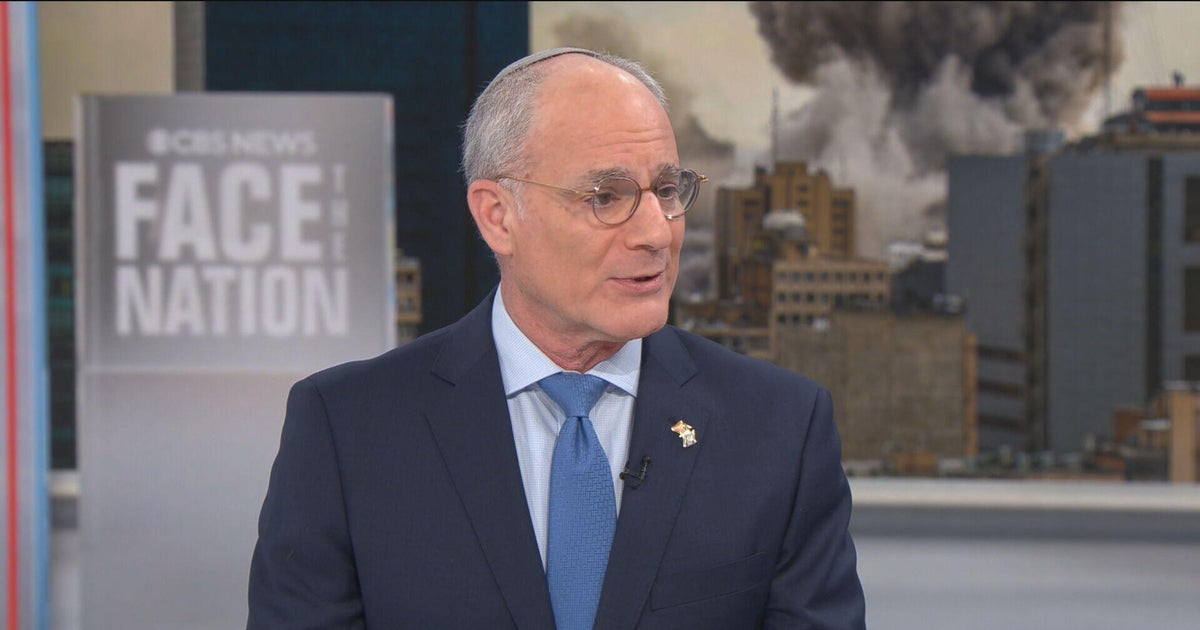
The following is the transcript of an interview with Israeli Ambassador to the US Michael Leiter that aired on “Face the Nation with Margaret Brennan” on April 12, 2026.
MARGARET BRENNAN: We are now joined by Israel's ambassador to the United States, Dr. Michael Leiter. Hello and welcome to the program.
DR. MICHAEL LEITER: Hello, Margaret, good to have you.
MARGARET BRENNAN: Israel and the US have been locked in this war until now. You heard the vice president leave the door open to diplomacy, but President Trump also said this morning, the US is locked and loaded for a good while. Is it your understanding that Israel and the US will hold fire until the end of this two-week ceasefire?
MICHAEL LEITER: We must remember that the President has been relentless in his pursuit of a negotiated end to this crisis. Those are the negotiations that preceded the June war, the negotiations that preceded the big rage, the negotiations are going on now, and I think that if we can end this problem with Iran, with this regime, this brutal regime, that is pursuing nuclear weapons without going back to kinetic work, it will probably be better for everyone. The president continues to pursue that. But now they see each other face to face, the vice president is sitting opposite this fellow, Qalibaf, who is directly responsible for the killing of his people in January, this past year in January, he just saw that they are stubborn and stubborn in pursuing nuclear weapons.
MARGARET BRENNAN: When you say the talks are ongoing, is there – is there any level of US-Iran contact right now?
MICHAEL LEITER: You know, the President has given this issue two weeks, and we're at the end of the first week, so there's another week left for further negotiations. We, we know the Iranians. We know this kingdom. We don't think they're going anywhere, but it's worth giving it a chance.
MARGARET BRENNAN: Vance said, we need to see Iran reaffirm its commitment to not seeking a nuclear weapon, or the tools that would enable them to acquire a nuclear weapon quickly. Is your understanding that the US position is zero enrichment or are they still leaving the door open for Iran to have a civilian and civilian nuclear program for medical purposes?
MICHAEL LEITER: A civilian nuclear program does not involve enrichment. There are 57 countries with nuclear non-enrichment programs.
MARGARET BRENNAN: — But they want less, you know that.
MICHAEL LEITER: No, no, if they had less then they would have more to move from 60% of what they had, to 90%. Look, you don't build these production plants deep underground if you're doing it for medicinal purposes, there's nothing to hide. These people lie. We should not be surprised if people who kill their own lie. This has been their pursuit. They have been singing for 47 years, the death of America, the death of Israel. That is their goal. We don't —
(CROSSTALK BEGINS)
MARGARET BRENNAN: — But we're negotiating with that same regime, right now —
MICHAEL LEITER: — We try at the same time to add that we are negotiating with —
MARGARET BRENNAN: — the same people.
(CROSSTALK ENDS)
MICHAEL LEITER: — We are negotiating with them, after destroying their army, after destroying their air force, after degrading their leadership. I hope they will come and kneel down and say, we surrender.
MARGARET BRENNAN: Well, the President said the war has been won. Your Prime Minister said the work is not done yet. Specifically, what part of Iran poses a military threat to Israel? Do you still consider it an existential threat?
MICHAEL LEITER: Well, there are three things we have to worry about in the first place. First, the pursuit of a nuclear weapon, if they go back to what concerns us —
MARGARET BRENNAN: — They say they're not —
MICHAEL LEITER: Number two, ballistic missiles. Okay, these ballistic missiles, they promise, by the way, that they don't have a ballistic missile that can reach Europe. They lied. We saw that they do.
MARGARET BRENNAN: — Are you talking about shooting Diego Garcia?
MICHAEL LEITER: Shooting at Diego Garcia. They said it was about 2000 kilometers. We see now they have 4000 kilometers. It's just a run to 8000 miles and hit Chicago or 10 to fly to New Jersey. So that's up to him
MARGARET BRENNAN: – US Intel says nine years.
MICHAEL LEITER: — and the proxy, well, our intel says it's less than nine years old. ok,
MARGARET BRENNAN: — Yes.
MICHAEL LEITER: And our Intel was right on this from the beginning. OK? Now it was clear that we said that they are in the race to acquire nuclear weapons. And Mr. Witkoff came back from the talks earlier and said that they went in, they went into the talks, and he said, we have prepared 60% of the 11 bombs. 11 bombs at 60% means you got a week or two until you get 90% and weapon range. And one last thing Margaret, proxies. Well, this is not over until there is complete coordination between Iran and its proxies that have spread death, chaos and destruction in the Middle East.
MARGARET BRENNAN: I want to go back to that in relation to Hezbollah. But just to finish what you're talking about smartly, there was this very detailed New York Times report this past week that, I know you've read, is extraordinary journalism. That explained more about the February 11 meeting where your prime minister accused President Trump of bombing Iran. It said that Israel's plan was to kill the Ayatollah, and it has been done. It cripples Iran's ability to threaten its neighbors, cause a revolution in Iran, and then carry out regime change, leaving the country's leader. Obviously, all those goals were not achieved. Can you declare the end of the war without reaching that checklist?
MICHAEL LEITER: First of all, all those goals have not been achieved. This is the process. This is not instant soup, number one. Second, I was in the room at that meeting. The reporters who wrote that article didn't and apparently got information the second time, the third time, there's a lot of bad news in that article that isn't true. Which is an intoxicating narrative, an interesting narrative, but an inaccurate one. So I would be very careful when quoting from that article.
MARGARET BRENNAN: Well, specifically, what, what are they wrong? Because they say your intelligence services, the Mossad say the Iranian regime will be so weak that it cannot choke the Strait of Hormuz. That was wrong. Iran would not be–
MICHAEL LEITER: No, no, we didn't object to that. We argued with the possibilities that we should work on that, nothing is presented as a fact, that if we do this, this will be the result. It is not science, politics is not science, military operations is not science. We presented the case that this is what we think should be done. The president makes the decision. All this stuff about the prime minister coming in dragging the president into this, – all you know for publicity purposes.
MARGARET BRENNAN: Did the Mossad believe that there would be demonstrations that would lead to a coup and that Kurdish fighters would enter the north?
MICHAEL LEITER: The Mossad thought that, as we saw in January, hundreds of thousands and millions of people rising up, the potential for that to happen is even greater now, and we still think it is greater. We still think we can, that might happen in the next few months but there's no guarantee –
MARGARET BRENNAN: — So why negotiate with the same government that oppresses those people?
MICHAEL LEITER: Well, you can negotiate
MARGARET BRENNAN: — Does Israel really support this negotiation?
MICHAEL LEITER: You can discuss – we support the president and his efforts. That's right, we've been locked in from the beginning in planning, implementation, and we're going to finish this thing together. So we fully support the president's efforts, both rhetorically and militarily.
MARGARET BRENNAN: For proxies, the Jerusalem Post today writes that Israel's war in Lebanon is the price Iran pays to reopen Hormuz. Israel's attack against Hezbollah, and for our audience, they are a political party in Lebanon and they are Iran's strongest military and host army. They're getting complicated here. The Trump administration held talks on Tuesday in Washington. You will be sitting at the table with the ambassador from Lebanon. Hezbollah is not part of these negotiations. At that time, will Israel slow down and reduce the strikes in Lebanon?
MICHAEL LEITER: If I may, point of correction, Hezbollah is a terrorist organization
MARGARET BRENNAN: — Right.
MICHAEL LEITER: — which is a political party as well. It is not a political party that also has a terrorist wing. They are a terrorist organization. They are representative of Iran,
MARGARET BRENNAN: — Yes.
MICHAEL LEITER: — with a plan to destroy the land of Israel,
MARGARET BRENNAN: — Yes.
MICHAEL LEITER: — And they shoot missiles at our towns and villages
MARGARET BRENNAN: — Yes.
MICHAEL LEITER: And we have to answer. Now, we want to negotiate with Lebanon. Lebanon and Israel can live in peace tomorrow. I believe, you know, we had this first call on Friday. It was a conference call, I –
MARGARET BRENNAN: — You and the Lebanese ambassador,
MICHAEL LEITER: The Lebanese Embassy, the American Embassy in Beirut, all overseen by State Department official Mike Needham. It was a great conversation. And the thing we all agreed on, is, if there was, if only we put Hezbollah aside and only Israel and Lebanon negotiate peace. Two months, three months, we have a complete peace agreement.
MARGARET BRENNAN: Let me follow up, you said Israel must be held accountable. That's different when it comes to responding to a Hezbollah strike against the kind of bombing we've seen this past week, especially on Wednesday. Airstrikes killed more than 350 people that day, a third of them women, children and the elderly, according to Lebanon's health ministry. The vice president said that Israel has agreed to take responsibility for these strikes. And the President said he talked to Bibi, your prime minister, and he said he will bring you down. Can you explain what low key bombing means? Is this a reduction in the cadence and volume of strikes from Wednesday. What exactly do the US and Israel agree on?
MICHAEL LEITER: Down cadence, up cadence. Labor issues are not discussed on Sunday morning television.
MARGARET BRENNAN: — Well, the president did
MICHAEL LEITER: – Well, we, what we have discussed is that we will go along with the president's efforts in the gulf, and we support the president's efforts. Right now, we are chasing those who fire missiles against our civilians, and Wednesday's operation targeted Hezbollah operational centers. Now, what do they do?
MARGARET BRENNAN: — Do you dispute those figures of the Lebanese government?
MICHAEL LEITER: Absolutely. Oh, right, it's like Hamas releasing figures from Gaza, their health ministry,
MARGARET BRENNAN: — But you are negotiating with the Lebanese government
MICHAEL LEITER: Absolutely, absolutely. But, sometimes, there is this attempt to paint us, you know, as going after the citizens. We are going after the target, the terrorist infrastructure. That's what we focus on. Now what Margaret is doing, is that they are putting their operational centers, their terrorist centers, among the civilians. Now we tell them to get out. They don't come out often, but we do what we can. Hamas is doing this in Gaza by building their bases inside the population centers. Hezbollah is doing it, and we saw the other day when Tehran sent its citizens to bridges and power plants so they don't exist, this is a crime against humanity.
MARGARET BRENNAN: Well, you have your own diplomacy on Tuesday, we'll be watching that and what happens. Thank you for your time this morning.
MICHAEL LEITER: Thank you
MARGARET BRENNAN: Come back right now.