Transcript: Sen. Chris Murphy on “Face the Nation with Margaret Brennan,” May 31, 2026

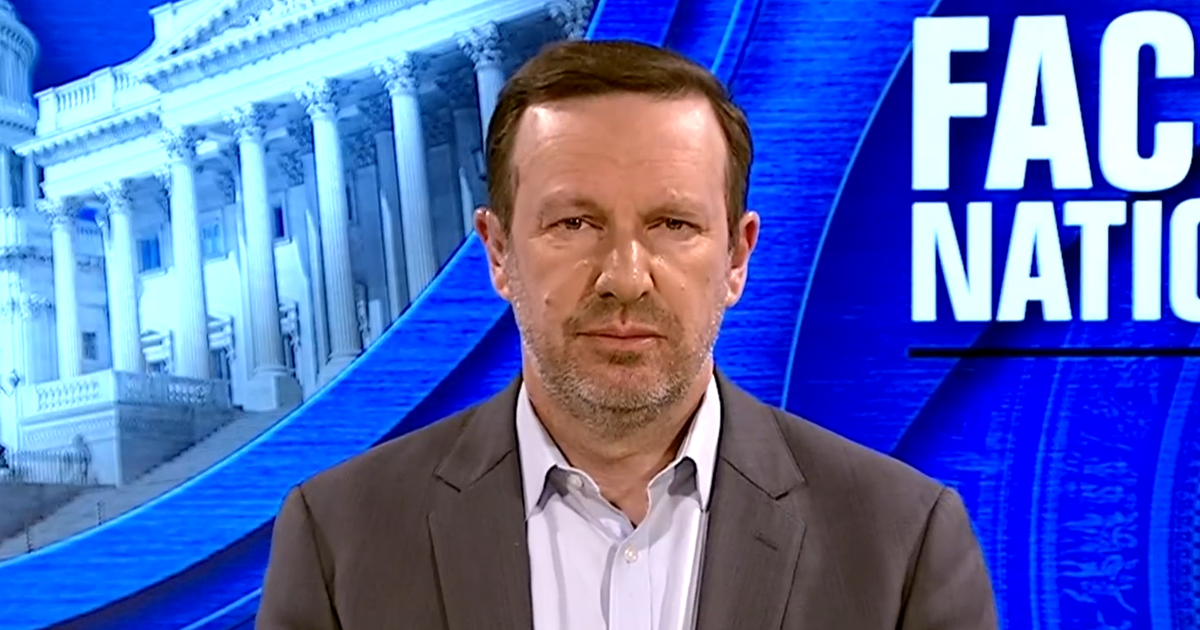
The following is the text of the interview with Sen. Chris Murphy, Democrat of Connecticut, aired on “Face the Nation with Margaret Brennan” on May 31, 2026.
MARGARET BRENNAN: And we're back now with Democratic Senator Chris Murphy. He is the author of a new book, Crisis of the Common Good: The Fight for Meaning and Connection in a Broken America. He joins us from Hartford, Connecticut. Hello to you, Senator.
SENATOR CHRIS MURPHY (D-CT): Good morning.
MARGARET BRENNAN: I want to talk about your book in a second, but just to pick up where we left off with President Zelenskyy, do you believe there's enough bipartisan support to pressure the Pentagon to further isolate some of these couples, so he can take down all the incoming Russian missiles?
SEN. MURPHY: Yeah, I doubt it. Unfortunately, I think the story here was too simple from the start. Donald Trump is unwilling to do what it takes to support Ukraine, and the Republican Party will always follow his lead. We've had two sanctions bills sitting on the Senate floor for a year and a half that would tighten the screws on the Russian economy, making it harder for them to finance the war. Donald Trump actually had a veto on that bill. He will not allow Senate Republicans to bring it forward. He is sitting on $400 million that Congress has allocated to help Ukraine. He never spent a dime of it, despite loud protests, both public and private, from Senate Republicans. So I think that Donald Trump has finally decided that he doesn't want to help Ukraine, and we don't seem to have enough courage in the Republican caucus to fight back. I mean, I hope I'm wrong about that. Obviously this is a critical time when Ukraine actually looks like it's going to be able to take a really offensive stance, so I reckon they're going to finally stand up to the President this time.
MARGARET BRENNAN: To your point, of the 400 million, Hegseth, the Secretary of War said that would be released, but we haven't seen anything else. I know you're sitting on the Appropriations Committee, so you have an opportunity to ask some of these questions, which Secretary Rubio, when he's sitting in front of you, I believe, on Wednesday, asking for a $33.6 billion budget. What's the best thing to do when you get to ask the secretary questions?
SEN. MURPHY: Well, the most important thing is to end the war in Iran. This has been a complete disaster for the United States. Obviously, the main impact is here at home, as families and businesses are hit by high fuel prices. They're $6 a gallon in some places, but it's just been embarrassing for the United States, and it's made Iran very powerful. Of course, it also affects Russia. We had to stop sanctions on Russian oil to get their oil on the market, so the result of the Iran war is not only that Americans die, prices go up, but Russia also becomes more powerful. We are funding their war effort, so we need the war on Iran to end. There has been this talk of an agreement for months and months and months. I think the terms of the agreement are humiliating in and of themselves, but we just need to get this war done, whatever the terms are, for now.
MARGARET BRENNAN: On the point about sanctions, we talked about that, President Zelensky, and you can see the full text online, but I know the White House is pushing back and saying that money is not that important in terms of what Russia can pocket. Obviously you don't agree.
SEN. MURPHY: Yeah, I mean, I think from a moral standpoint, even if money makes a difference, the idea that we're helping Russia fund this war is ridiculous. It's not small potatoes.
MARGARET BRENNAN: Yes.
SEN. MURPHY: Russia is getting billions of extra dollars because of our sanctions relief, which allows them to buy more missiles that fall on Kyiv. People are dying because of our help in Russia. So, it's bad enough that the Strait of Hormuz is closed and it's hurting our economy. The fact that we are adding insult to injury with the Iran war helping Russia is unacceptable.
MARGARET BRENNAN: You wrote this book that we mentioned, and I know you mentioned in a recent interview that the 2028 Democratic candidates are texting you, talking to you about some of the ideas in it. One of our recent CBS polls found that 62% of registered voters view the Democratic Party unfavorably, so how do you take these views, and what's the key thing Democrats need to reorient the party?
SEN. MURPHY: Yes, this book is about the spiritual crisis in the country that led to Donald Trump. This is a country that feels very lonely, very disillusioned, very tired of an economy that abuses workers, a culture where we tell people that they can enjoy themselves by just buying things instead of being active citizens, so this is a book about the basic work that we have to do to destroy the economy, so that people feel meaningful and important, and waste our democratic power, so that people feel free. And that's really what the book is about, the emotional state of the world. Here's what I think the Democrats need to do: they need to understand that people are angry that our politics have been taken over, and people feel that they can no longer control their lives because they think that we are all corrupt. Thinkers–
MARGARET BRENNAN: Yes.
SEN. MURPHY: –Donald Trump is just evil; they think that everyone in politics is corrupt. So, Democrats need to be more vocal about how we're going to get billionaires and corporate money out of our politics, because people don't believe us when we say we're going to fix the economy–
MARGARET BRENNAN: Right.
SEN. MURPHY: –if we don't tell them how we're going to fix our democracy.
MARGARET BRENNAN: All right, until then about spirit and character, Graham Platner's campaign confirmed to CBS on Saturday that the Maine Senate candidate sent sexually explicit texts to women other than his wife. This is more than other previous conflicts. Do you pass the character test?
SEN. MURPHY: Yeah, I mean, I haven't followed this story as closely as some have, but Grant Platner is a man who serves our country, he served his community, and he made mistakes.
MARGARET BRENNAN: Yes.
SEN. MURPHY: And you admitted that. Morality also includes standing up to people who make money and are corrupt in this country, and this race will be the difference between someone who has put his life on the line for this country versus someone who is truly empowering the moral hacking of our nation in the White House. So he admitted that he made mistakes, but I think this is going to be a clear difference in Maine between someone who has spent his life protecting us, versus someone who appears to be protecting the corruption of Donald Trump.
MARGARET BRENNAN: You know, I also want to ask you about the interview that aired before this show with my colleague Rita Braver on CBS Sunday Morning. He interviewed First Lady Jill Biden about a new book he wrote, in which he talks about the infamous 2024 debate, in which the then-president could not answer questions. She says a lot of things, including that she thought her husband was having a stroke because he was incoherent. He admits that he told her afterwards that he broke up, but that's what he's revealing now. Democrats, strongly, including this program, have repeatedly said that his cognitive abilities were fine. How do you convince the public that Democrats are telling the truth now?
SEN. MURPHY: Yeah, listen, I think the Democrats should be honest about the mistakes we made in 2024. Obviously, in retrospect, Joe Biden should have dropped out of that race. We should have had an open competition. And in this book, I speak frankly about how our politics has become tribal, how the Republicans are willing to justify the corruption of Donald Trump, because their entire identity structure is built around their party. And I think that happens on the Democratic side, where we're willing to look the other way too often at the mistakes our party leaders are making, and this book says that's not just political to fix that. In fact we should create more healthy identity structures for people outside politics, so that they can see their purpose through their work or through their connection with the local community. And that makes our politics non-racial–
MARGARET BRENNAN: Right.
SEN. MURPHY: –and maybe it allows us on both sides to stand up to our party if we think they're not doing well.
MARGARET BRENNAN: All right, Senator Murphy, we should leave it there. Thank you for your comments today. We'll be back with more Face the Nation.