Comcast Corp. NASDAQ: CMCSA dipped into the familiar playbook this week. But after the first pop, the CMCSA goes back to its pre-announcement levels.
Comcast Today
As of 07/2/2026 04:00 PM Eastern
- 52 week interval
- $22.13
▼
$36.40
- Dividend Yield
- 5.55%
- The P/E ratio
- 4.68
- Target Value
- $34.40
This is not the time to sell. It's the traders who do what they do, making a quick profit on issues that don't do much for Comcast's business.
The announcement was a spinoff of its NBCUniversal, Peacock, Universal Studios, and Sky business units into a second new public company. Comcast will retain a minority ownership stake but plans to divest it over time. The movement makes sense. Content creation in the broadcast space is a competitive, cash-intensive business. Although Comcast still posted stable revenue and earnings, the idea is that this move will unlock more value.
A New Chapter in an Old Playbook
Investors familiar with Comcast may think they've been here before. They have it. Recently. In late 2025, the company announced that it was spinning off many of its cable channels, such as CNBC and USA Network, into a new company, Versant. NASDAQ: VSNT.
VSNT went public in mid-December, and early returns have been negative. The stock is down just over 20%. That may be proof that Comcast was smart to fire that business. But that doesn't mean a small, focused business will deliver the growth investors expect.
Aside from being an outperforming stock, do analysts have reason to re-rate Comcast? Since the announcement, Comcast analyst forecasts on MarketBeat have made the decision to split. Rosenblatt Securities upgraded CMCSA from Neutral to Buy and increased their target price from $24 to $31. Deutsche Bank also upgraded the stock from Hold to a Buy, but lowered the price target to $32 from $34.
Next up…Profit
Investors won't have to wait long to learn about the company's next moves. Comcast is expected to deliver its Q2 2026 earnings report on July 23. While information about the company's strategy is important, the more important question may be when investors can expect to see a return on that investment, as it relates to margins and profits.
They may have to wait a while. In its previous earnings report, the company reported that residential broadband net loss improved year-over-year to (65K) , and the company added 435K wireless lines. It was the best quarterly result on record.
However, it also showed that the broadband market is mature. Without a new catalyst, what should investors realistically expect?
Technical Image Shows Declining Momentum
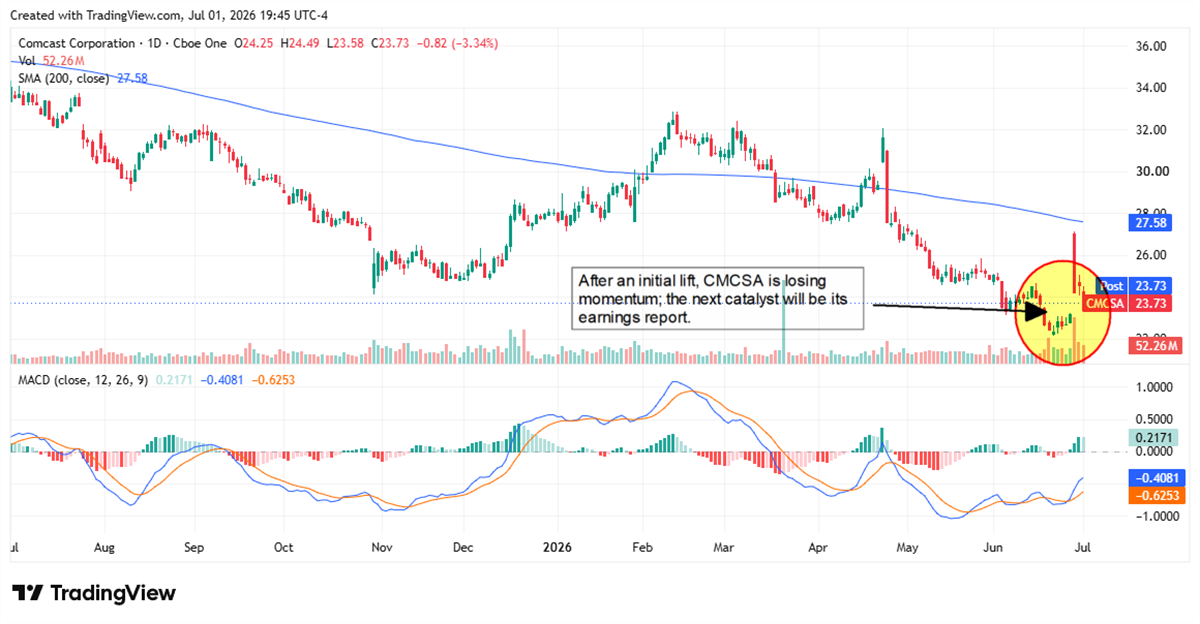
Over the long term, the stock chart tells a story. After the spike in 2020, CMCSA has been steadily declining. The Versant spinoff and now this new acquisition has done nothing to reverse the slide.
However, in the short term, the charts can show momentum. At this point, any momentum Comcast had is starting to fade.
Know What You Have
None of this suggests that CMCSA is unworthy of ownership. First, the company is attractively valued at a forward price-to-earnings (P/E) ratio of 6.8x. That's not only a significant discount to the broader market, but also a discount to its historical average.
But investors should know who they are. In Comcast's case, that's like stock in use. It has a legacy business that often brings in sticky income. In addition, the company has a near monopoly in the areas in which it operates.
But it's not a fast-growing business. Even though broadband is something many consumers won't give up, Comcast's pricing power is limited by increasing competition from satellite offerings. Consumers may not have many alternatives, but they have enough to keep Comcast's prices in check.
That's important to how investors should size a position. Comcast isn't fighting for market share the way the stock is growing. It controls the decline in margins while protecting the price power where it still exists. Spinoffs, Versant and now NBCUniversal's work is better read as a portfolio triage than a turnaround story.
Management is narrowing its focus on parts of the business that still throw off predictable cash, which is a defensible strategy for a mature investor, but not one that typically re-rates the stock higher. Investors chasing the next catalyst may be disappointed. Investors looking for income backed by a long-lived, if slow-growing, business have even more reason to stick around.
One reason for investors to stay tuned would be the safe dividend yield of 5.6% as of the market close on July 1. Also, the company has raised its dividend for 18 years in a row. There is a place for CMCSA in other portfolios, but it should not be confused with growth stocks.
Before you consider Comcast, you'll want to hear this.
MarketBeat tracks Wall Street's top and most effective research analysts and the stocks they recommend to their clients every day. MarketBeat identified five stocks that top analysts are quietly whispering to their clients to buy now before the broader market catches on… and Comcast wasn't on the list.
Although Comcast currently has a hold rating among analysts, top analysts believe these five stocks are the best.
View Five Stocks Here
Nuclear power is entering a new cycle of growth as increased energy demand, increased data centers, and renewed policy support bring the sector back into focus. After strong gains in recent years, the most impactful phase of investment in nuclear may be ahead. The report highlights seven nuclear power stocks positioned across the value chain—including near-term revenue and long-term upside as a next-generation technology scale. Click the link below to open the full list.
Get This Free Report