Financing Growth: The Role of Sustainable Banking in the Ethiopia-Djibouti Trade Corridor

The Ethiopia-Djibouti Corridor is at the center of this transition, serving as Ethiopia's main import and export gateway.
For financial institutions like iibGroup, the role of banking goes beyond the provision of funds. It is about allocating capital to support economic sustainability, strengthening trade ecosystems, and delivering measurable social and environmental impact.
Embedding Sustainability at Scale
Unlike traditional ESG approaches that operate as stand-alone programs, iib East Africa integrates sustainability directly into its core funding model. As of 2025, more than 80% of the bank's lending was accompanied by ESG-related financing, indicating a deliberate shift to impact-driven banking.
This represents a 20% growth in ESG-compliant financing from January 2025, driven by growth in renewable energy, infrastructure financing and trade finance solutions for ESG-compliant businesses. This scale of integration positions it as an ESG-focused financial institution in Djibouti.
Supporting Trade in ESG-Compliant Finance
Trade finance remains the backbone of East African economies, yet many SMEs in key sectors continue to face limited access to formal finance.
iib East Africa has expanded its dedicated trade finance facilities to ESG-compliant SMEs, particularly those involved in food import/export and essential commodities. These institutions support regional food security, responsible supply chains and sustainable cross-border trade.
By combining trade finance with ESG principles, the bank ensures that capital not only supports commercial growth, but also broader economic stability and stability.
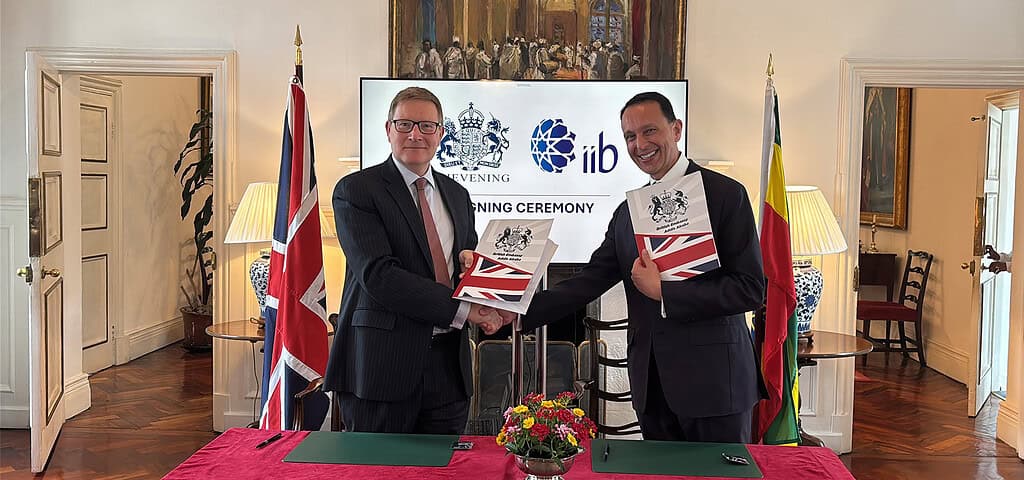
HE Darren Welch, UK Ambassador to Ethiopia and Permanent Representative to the African Union, and Sohail Sultan, Chairman of iibGroup at the Chevening Scholarship signing ceremony in Addis Ababa.
Fundraising for High-Impact Activities
Beyond trade finance, the iib raises capital at scale through structured sustainable finance programs.
A key development is a US$72.5 million program, which includes a US$30 million social bond program, a US$25 million Green Bond, and a US$17.5 million Blue Carbon program.
The public bond program is designed to finance high-impact projects including affordable housing, regional food security, critical telecommunications infrastructure, education and healthcare, and ESG-compliant SME capital.
The Green Bond will improve energy efficiency in industry and transport SMEs.
Meanwhile, the Blue Carbon program will restore 1,675 hectares of mangroves, conserve another 780 hectares, create a protective barrier of 400 hectares and target the sequestration of 2 million tons of CO₂. And with a projected investment of US$17.5 million and an expected IRR of more than 20%, it shows how sustainable investments can generate both commercial benefits and measurable environmental results.
It extends to Ethiopia
By establishing a Representative Office in Addis Ababa, iibGroup has taken an important step in expanding this model into one of the largest and most promising markets in Africa.
This expansion supports iib's strategy to act as a regional financial intermediary, facilitating cross-border trade, investment and capital flows between East Africa and international markets.
Supported by a strong banking network with more than 30 relationships across Ethiopia and the wider region, the bank provides trade finance, structured trading, cross-border payments, foreign exchange, cash management and risk participation solutions.
With its presence in Djibouti and Ethiopia, the iib is in a position to connect local businesses with international capital while supporting trade, infrastructure and private sector growth throughout the corridor, strengthening its role as a regional connector.
Driving Social Impact Beyond Financing
In frontier markets, sustainable finance goes beyond balance sheet activity. iib East Africa complements its financing activities with direct community engagement that promotes inclusive growth.
By 2025, this includes:
- Food distribution programs targeting vulnerable communities.
- Literacy programs and academic support.
- Environmental campaigns including beach cleaning and tree planting.
- Health awareness programs, including breast cancer awareness programs.
In addition, the bank is financing a housing project in partnership with Qatar Charity, which involves the construction of 79 houses, as well as an Islamic center and an Islamic education center, representing a total investment of about US$500,000.
These programs reinforce the principle that sustainable finance should create an impact on institutions and society.
A Sustainable Banking Model for Frontier Markets
As financial systems in East Africa continue to develop, banks are becoming active supporters of economic development rather than financial intermediaries.
iibGroup's approach – focused on ESG integration, trade facilitation and capital mobilization – shows how sustainable banking can be successfully implemented in edge markets. By combining financial performance with measurable impact, the bank contributes to the development of a strong, inclusive and interconnected regional economy. On the Ethiopia-Djibouti route, this model is not only important; it is important.

The post Financing Growth: The Role of a Stable Bank in the Ethiopia-Djibouti Trade Route appeared first on World Finance magazine.