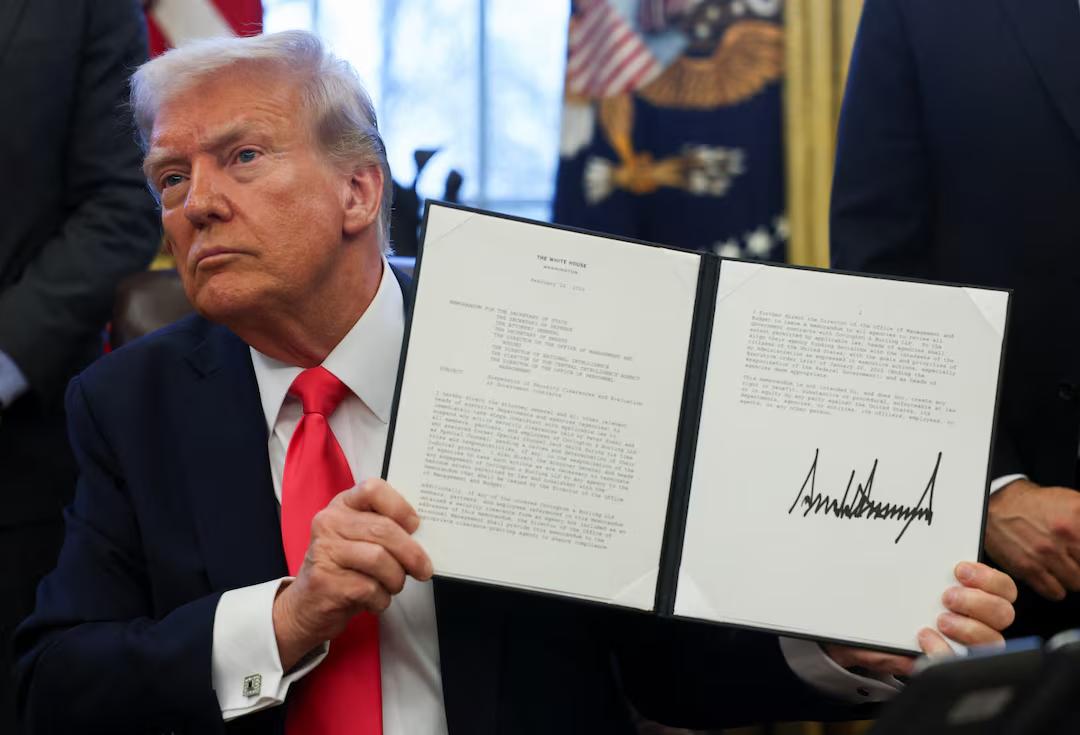
The president Donald Trump signed an executive order on Tuesday that creates a voluntary federal review process for some of America's most advanced artificial intelligence programs, a move that reflects growing concern that the rapid development of AI is beginning to outpace safeguards designed to control its risks.
While the White House introduced the order as a national security measure, it comes at a time when businesses, workers and investors are already adapting to technology that could reshape how large parts of the economy operate.
The order allows developers of certain advanced AI models to voluntarily give the federal government access to those systems up to 30 days before a broad rollout. Officials say the goal is to strengthen cyber security, protect critical infrastructure and maintain America's technological advantage over rivals like China. Administrators reiterated that participation remains voluntary and does not create a licensing system for AI development.
The government's involvement in this phase shows how quickly AI has moved from an emerging technology to a force capable of influencing major economic decisions. Companies across the technical, financial, consulting and technology sectors are investing heavily in systems that can analyze information, write reports, generate software code and perform tasks that until recently required human workers.
Few economists expect artificial intelligence to eliminate dozens of jobs overnight. Change is seen differently. Businesses that were once expected to expand large numbers are increasingly evaluating whether certain roles need to be filled at all. Vacancies are still being updated. Spending that would otherwise have gone towards hiring has, in some cases, been redirected to technology infrastructure and innovation projects.
Those changes may seem modest on their own, but they can reshape labor markets over time. Fewer openings, less hiring and more competition for skilled positions can leave employees asking questions they thought were honest. In an economy already grappling with inflationary pressures and the high cost of living, even subtle changes in employment can affect the way families plan, spend and save.
Major AI companies include OpenAI, Anthropic again Google adopted a management approach, describing it as a constructive measure to balance innovation and security.
Proponents argue that stronger cooperation between government and industry can help prevent powerful AI systems from being exploited by hackers or malicious outside actors. Critics, meanwhile, have questioned how officials will decide which models get more scrutiny and whether federal agencies should have such a broad understanding of the rapidly evolving technology.
Outside of Washington, most people are unlikely to focus on the details of the review process. Their attention is likely to settle on a simple question: what does it quickly AI development means jobscareer progression and long-term financial security?
Changes in trust rarely come all at once. They tend to appear gradually in everyday decisions. The family waits for a while before moving the house. An employee stays put instead of chasing a new opportunity. The company is holding off on filling the vacancy while executives explore where the technology could fit into future operations. None of those decisions make headlines by themselves, but together they can change the rhythm of the economy.
The White House order focuses on national security, but it also serves as a reminder of how important AI has become to the broader economy. Governments are scrambling to understand its capabilities while companies are spending billions to integrate it into their operations. Together, those developments suggest that AI is moving from a specialized technology to something that can influence decisions in the wider economy.
That change can create huge gains in productivity and innovation, but it also forces workers and businesses to make decisions with fewer assumptions about what's next. As investment accelerates and expectations in the workplace continue to evolve, many families find themselves in an unusual position: planning for the future while the labor market landscape becomes increasingly difficult to read.