 
Author: Alexandre Barbosa, Chief Financial Officer, Sicredi
In a world increasingly shaped by climate change, social inequality and economic uncertainty, the role of financial institutions is being redefined. Beyond profit, there is a growing need for models that can deliver long-term value while addressing pressing environmental and social challenges. Within this context, the credit union system has emerged as a powerful and scalable solution. By combining financial strength with a deep commitment to local development, cooperatives are uniquely positioned to deliver services in an inclusive and impactful manner. This model achieves great value in scale, as shown by Sicredi, one of the largest financial institutions in Brazil, with more than 10 million members, more than 3,000 branches and present in more than 2,200 municipalities.
This consistent and significant impact was recently recognized at the World Finance Awards, where Sicredi was named the winner in the category 'Outstanding Contribution to Sustainable Finance by Cooperative (LatAm).' The award recognizes institutions that not only promote sustainable finance, but also reshape the way financial systems contribute to inclusive and low-carbon development.
Long-term development
The core of Sicredi's strategy is the integration of environmental and social criteria into credit decisions, ensuring that financial solutions contribute to long-term development. This approach has driven the expansion of its green credit portfolio, reaching $17.8bn by 2025, reflecting a consistent effort to align financial performance with sustainability outcomes. The green credit portfolio is defined by a strong classification framework that includes sector criteria, eligible credit lines and clearly identified environmental and social benefits. Sicredi accepts the sustainability tax proposed by the Brazilian Banking Federation (Febraban), which is compatible with internationally known references such as the Climate Bonds Initiative, the European Union taxonomy and the Social Bond Principles.
The coalition also plays a leading role in supporting underrepresented groups
In practice, activities are classified as green when they support activities that contribute to the transition to a low-carbon economy, climate adaptation and resilience, sustainable land use, renewable energy production, resource efficiency, biodiversity conservation or social inclusion in vulnerable areas. In addition to the objective of the financed activity, credit decisions also involve assessing social, environmental and climate risks, ensuring compatibility between sustainability results, financial soundness and long-term development.
Within this strategic framework, $1.9bn is allocated to low carbon agriculture. In parallel, Sicredi has also established itself as a leading financier of renewable energy, with a portfolio reaching $4.3bn, mainly supporting the expansion of distributed solar generation. This investment enables producers to use techniques such as crop rotation, efficient water use and biodiversity conservation, strengthening both environmental outcomes and agricultural sustainability. Sicredi's impact extends beyond environmental programs. Through its operations in small municipalities, rural areas and underserved regions, cooperatives play an important role in increasing financial inclusion and stimulating local economic development. As a result of this presence, $5bn is directed to micro and small businesses located in municipalities with below average levels of human development.
Economic development
The coalition also plays a leading role in supporting underrepresented groups. Its portfolio dedicated to women-led businesses will reach $1.8bn by 2025, strengthening access to credit as a driver of economic empowerment, income generation and social inclusion. Strategic partnerships also amplify this impact. Cooperation with international institutions such as the International Finance Corporation (IFC) allows for the pooling of global capital into domestic efforts, combining financial resources and deep local knowledge. This integrated approach strengthens the capacity to deliver such a large and measurable impact in various regions.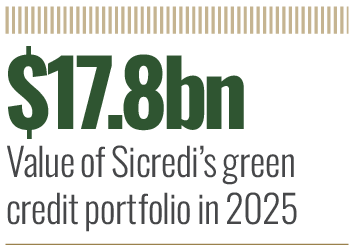
Taken together, these aspects show that Environmental, Social and Governance (ESG) considerations at Sicredi are not considered as a separate agenda or a shadowy layer, but as an expression of its essence and an integral part of its business model and the cooperation system itself. The integration of social, environmental and governance criteria guides strategic decisions, credit allocation, risk management and relationships with members and communities.
As sustainability becomes central to global financial systems, Sicredi demonstrates that the credit union system can play a transformative role in shaping an inclusive and resilient economy. By aligning financial performance with social and environmental impact, the partnership model offers a compelling approach to sustainable development – not only in Brazil, but as a reference for financial systems around the world.