People, machines or nothing: The future of court documents hangs in the balance

The California Supreme Court is poised to rule in a case that has pitted state court reporters — workers who document court cases — against domestic violence victims and other vulnerable defendants.
The case will decide whether to end a long-standing ban on electronic recording of many civil court cases, which allows the use of modern technology to create a “verbatim record,” which is important in appeals and other legal challenges.
Advocates say a ruling in favor of electronic recording could end a years-long judicial crisis almost overnight, produce legal records and preserve the right to appeal in tens of thousands of cases in civil, family and trial cases where court reporters are not provided. Participants in public proceedings can hire private stenographers to keep a record of what is said, but their services can run into thousands of dollars per day.
“In many courthouses across the state today, there is no one there, and there will be no one there,” attorney Sonya Winner told the high court during arguments in Los Angeles last month. “Court reporters that the court has on staff have gone out to cover cases,” making electronic recording the only option for many litigants.
Everyone agrees the shortage of court reporters is a problem. Lawyers for both sides urged the high court to enunciate a clear right to access to the audio record in civil proceedings.
The split is over whether the labor shortage is getting better or getting worse, and what the Supreme Court should do about it.
California's largest public sector union and independent court reporters are warning that the decision could allow state court systems to stop hiring stenographers.
Court reporters say their duty to keep an accurate record is a deep public trust that only a person can step in to make sure everyone is heard and who takes responsibility if a transcript is lost or incomplete.
Despite a sluggish California job market, hiring court reporters remains brisk, bolstered by tens of millions in funding from Sacramento, a recent change in state law and aggressive hiring in some of the state's largest court systems, including Los Angeles, Orange and San Diego counties.
Lila Scott, a TV writer, is among those who want to join the project. Like most Hollywood talent, he has struggled to find steady work in recent years.
The author of “Unicorn Academy” was trawling government job sites when he found a list of court reporters in Los Angeles – and another, and another.
“I thought, 'What is this?'” Scott recalls as he prepared for class at Downey Adult School.
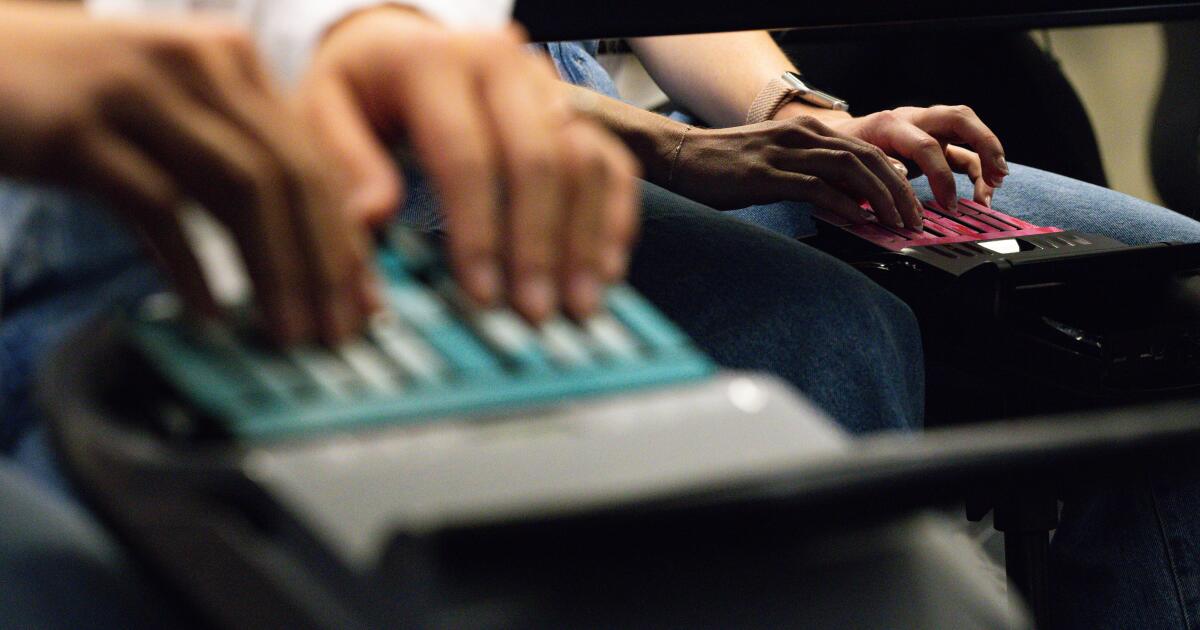
Scott is now trained as a “voice writer,” a note-taking technique that relies on a device called a stenomask — something like a cross between a podcast microphone and a nebulizer — to produce a transcript. Voice recorders repeat every word spoken in court along with a series of formatting instructions in the voice recognition software.
“You use your mother's voice when you say something,” said another Downey student, 40-year-old Wanda Port. “That mother's strong voice, that's what you use.”
Traditionally, court reporters have used 22-key steno machines to quickly remove all words spoken by lawyers, jurors or anyone else speaking from the record during a trial. The licensing process for these stenographers is much longer and more difficult than that of voice writers.
For the record:
7:44 am July 6, 2026A previous version of this article stated that the California law allowing voice writers to be licensed as “certified short reporters” changed in 2024. The law came into effect in 2023.
A change in state law in 2023 allowed transcriptionists to obtain licenses as “certified stenographers,” opening a new pipeline of court workers.
About half of the court reporters employed in California by 2024 are transcriptionists, the data show.
“Of the more than 300 students we have, it's about 50/50,” said Jennifer Shenbaum, who directs the Downey program.
The current hiring blitz follows a more than decade-long decline, after California court systems cut nearly a third of their reporters during a protracted budget crisis in 2012. Labor leaders say new licenses have jumped ninefold in recent years, and court reporting classes across the country are full.
Diana Van Dyke, a reporter for the Los Angeles County Superior Court and a shop steward at Service Employees International Union Local 721, credits that growth to an increase in paid internships, signing bonuses and other predatory recruiting tactics sponsored by the Legislature and encouraged by the union.
Students training to be court reporters practice stenotypes and stenomasks during a speed building class at Downey Adult School.
(Kayla Bartkowski/Los Angeles Times)
At Orange County's Cypress College, which offers court reporter training, job fliers boasting the salaries of six people are plastered on the walls. A flyer from the Central District of California that advocated “Federal cases on the front page” hung in the window of a court reporting class, where students practiced typing 200 words per minute.
“At the end of the third test I can no longer feel my fingers — but it suits me!” said Asia Mendez, a trainee stenographer.
Although advocates for court reporters say humans can still do a better job than machines, the fact that many hearings take place without any formal transcripts has raised concerns among the country's top officials.
He said. Gen. Rob Bonta called the situation “unacceptable.”
“This is a rare case where the current request for law violates due process,” Bonta's office said in a brief urging the state's highest court to allow the recording.
Such a decision would be especially important for survivors of domestic violence, who often find the family court system to be a target for them, said Jennafer Dorfman Wagner, director of programs for the Family Violence Appeals Project, which brought the case now before the California Supreme Court.
“People who want to exercise power and control over their old partners will find any strength they can use,” Wagner said.
Without a record of their trial, accusers cannot prove what happened in court, or appeal if a judge refuses a restraining order or approves a detention plan that leaves them at risk of further violence.
California court systems have also thrown their weight behind the plaintiffs in the case.
“California has long been a leader in areas of access to justice and technology, but in this area, it lags far behind the rest of the country, and behind the federal courts in this state,” said Mark Yohalem, an attorney representing the state's highest courts.
Judges, too, seem eager to accept electronic recording in cases where a court reporter is not present and the defendants cannot afford to pay for it themselves, repeatedly pressing lawyers on how to record the decision.
Although the decision will not affect criminal proceedings, high court judges have expressed concern that court systems could use their decision to cancel the recruitment drive as a cost-cutting measure – a concern for labor leaders.
“Electronic recording is cheap,” said Judge Joshua P. Groban. “It allows any court to simply say, for example, that court reporters are no longer needed.”
When lawyers for the Family Violence Appeals System told Groban and the other jurors hearing the case that such a move by the courts would amount to “bad faith” and should not be considered in their decision, the judge seemed skeptical.
“It's either bad faith or fiscal responsibility, depending on that year's budget,” Groban said.